The full façade of the Library of Celsus with visitors on the forecourt and the Mazaeus-Mithridates Gate at right

Ephesus

An ancient harbour city on Turkey’s Aegean coast. Settlement in the surrounding area dated back to the Neolithic period.

Ephesus is an ancient city on the Aegean side of Turkey, whose ruins stand beside the town of Selçuk in İzmir province1. It was a Greek city from the early Iron Age2, the seat of Rome’s governor of Asia3, home to one of the Seven Wonders4 and a place where early Christianity took shape5. UNESCO added it to the World Heritage List in 20156. Austrian archaeologists have been digging here since 18957, and much of what is known about the city comes from that long campaign.

Historical claims are checked against independent sources; visitor information is traced to its issuing authority.

In this section

What is Ephesus?

The name Ephesus has belonged to several places over the centuries. The marble streets, theatre and library that most people picture are the Hellenistic and Roman city Lysimachus built in a valley between two hills12. UNESCO’s listing reaches further, to four areas: the prehistoric mound of Çukuriçi, the ancient city itself, Ayasuluk hill with the site of the Artemision and its medieval remains, and the House of the Virgin Mary13.

It was large and rich. Strabo, writing under Augustus or Tiberius, called it the biggest trading centre in Asia on this side of the Taurus14. Its population is argued over: the older literature gives 200,000 or more15, while a recent demographic model arrives at about 71,60016. By the 2nd century AD, in Walter Scheidel’s ranking, it was one of the five biggest cities of the Greek and Roman world17.

The Library of Celsus seen from the hillside above the lower city
Fig. 1 The library and lower city, seen from the hillside.

Where is Ephesus?

Ephesus is in western Turkey, in the lower valley of the Küçük Menderes, the river the Greeks called the Kaystros18. The site has ticket offices at a northern and a southern gate, both shown in the Ephesus route schematic19. Kuşadası’s cruise port is roughly 19 km away by road20, and İzmir’s airport about 62 km21.

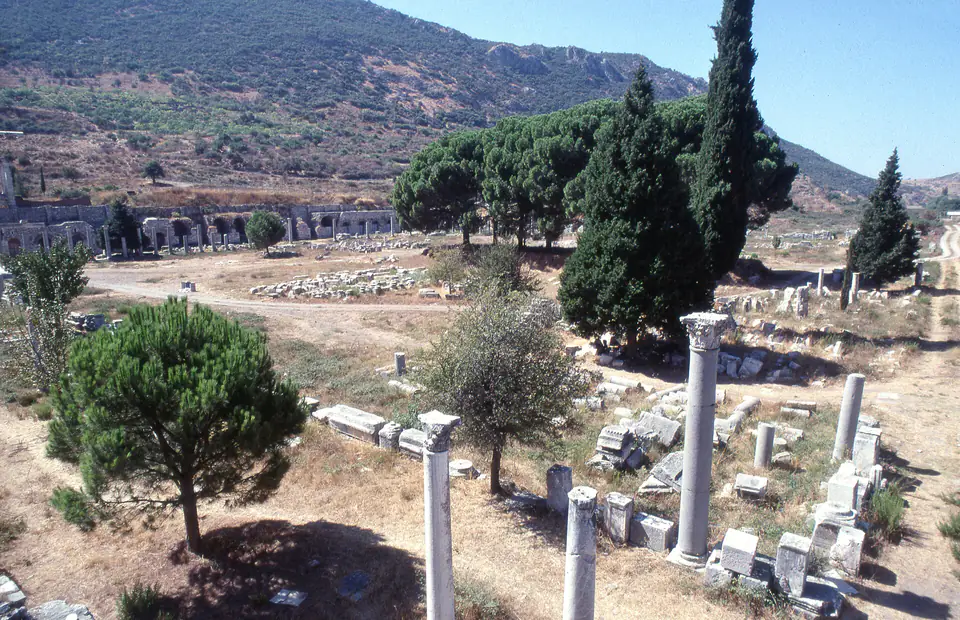
For a harbour city it now sits oddly far inland, with its old harbour basin reduced to a marshy lake22. The river’s silt is to blame: over thousands of years it has driven the coastline away from Ephesus23.

The valley below Ephesus from the upper city, with crowds far below
Fig. 2 The valley below the upper city.

A city that followed the sea

No single spot can claim to be the whole of Ephesus. The first villagers lived at Çukuriçi Höyük8. In the Late Bronze Age the hill of Ayasuluk was probably Apaša, the capital of Arzawa known from Hittite texts24. Strabo says the Greek town came down from the mountainside to the temple of Artemis in the time of Croesus25.

The Ephesus of today dates from the early 3rd century BC, when Lysimachus forced the population into a new walled city12. The old harbour was silting up, while the new bay still had deep water26. Much later the movement ran the other way, and settlement drifted back to fortified Ayasuluk, though parts of the old city were still lived in until the 12th century27.

Visitors walk along a broad marble street between rows of columns
Fig. 3 Harbour Street, the later monumental approach towards the ancient harbour.

Ephesus through the ages

The history of Ephesus runs from the Neolithic to the Ottomans. A few markers give its shape:

  1. c. 6700 BCFirst settlement at Çukuriçi Höyük8
  2. c. 560 BCCroesus of Lydia takes the city28
  3. 356 BCHerostratus burns the Temple of Artemis29
  4. 334 BCAlexander the Great takes Ephesus from the Persians30
  5. Early 3rd century BCLysimachus refounds the city on its present site9
  6. 133 BCAttalus III leaves his kingdom to Rome31
  7. 260s ADEarthquake and Gothic raids32
  8. 431 and 449Two church councils meet at Ephesus33
  9. Mid-6th centuryJustinian builds the Basilica of St John34
  10. 1304The town surrenders to Turkish forces35
  11. 1375The İsa Bey Mosque is built36
  12. 1869John Turtle Wood finds the Temple of Artemis37
  13. 1895Austrian excavations begin7
  14. 2015World Heritage listing6
The crenellated walls and square keep of Ayasuluk castle on the hilltop
Fig. 4 The crenellated walls and square keep of Ayasuluk castle on the hilltop. Archive photograph (1992).

The ruins: what stands today

The ancient city is best experienced as a slow walk downhill. From the Hercules Gate, Curetes Street drops through the valley to the Library of Celsus38, built in honour of Tiberius Julius Celsus Polemaeanus, whose vaulted tomb chamber lies beneath it39. Its two-storey façade plays a trick of scale: the pedestals under the lower columns grow taller towards the edges, so the front looks bigger than it is40. An earthquake probably brought it down in the 10th or 11th century41, and between 1970 and 1978 it was re-erected from its own blocks42. The building has never left Ephesus43; only the originals of its four statues went to Vienna, and copies fill the niches now44.

Marble Street leads on from the library towards the theatre45. The Great Theatre is the one named in Acts, where the crowd shouted for Artemis during the silversmiths’ riot46. How many it held is disputed: the Austrian excavators reckon about 20,000 after the Roman enlargement, fewer than the 24,000 or 25,000 given in many other sources47.

On the slope above Curetes Street, the Terrace Houses are a block of Roman homes covering about 4,000 m²48, divided into seven residences49. Their wall paintings of the 2nd and 3rd centuries are the largest group of their kind from the Roman East50, and a protective roof has sheltered them since 1999/200051.

Across the street stands the Temple of Hadrian, dedicated by Publius Quintilius Valens Varius to Artemis of Ephesus, the emperor and the people52. The scholars who have studied it are not agreed that it was a temple of Hadrian at all53. A little further down Curetes Street is the Octagon, an eight-sided tomb54 long claimed for Cleopatra’s sister Arsinoe IV; a DNA study published in 2025 showed that its skeleton belonged to a boy aged between 11 and 145556.

View from the high seats of the Great Theatre down to the orchestra and valley
Fig. 5 A view down from the theatre’s upper seating.

The Temple of Artemis

The Temple of Artemis made Ephesus famous across the ancient world. Antipater of Sidon put it on his list of wonders, saying that beside it the others lost their brilliance4. Pliny credited the later temple with 127 columns, each the gift of a king57. Modern reconstructions cannot fit that many; the most recent argues for 109 at most58.

Its site was lost until John Turtle Wood reached the remains on the last day of 1869, some 6 m down37. The lone column there today was reassembled from fragments that did not all come from the same original column59. Stone from the temple did end up in later buildings nearby, the Basilica of St John among them60, but the story that Hagia Sophia has columns from Ephesus is a medieval legend61.

The goddess worshipped here was not quite the Greek huntress. From late antiquity the rows of oval shapes on the chest of the Ephesian Artemis were read as breasts; modern scholars reject that reading or call it unproven, and propose ornaments, amber pendants or regalia instead62. Two celebrated Roman statues of her, found in the city’s town hall in 1956, are now in the museum at Selçuk63.

The re-erected Artemision column with the İsa Bey Mosque and Ayasuluk castle behind
Fig. 6 The re-erected Artemision column with the İsa Bey Mosque and Ayasuluk castle behind. Archive photograph (1992).

Ephesus in Christian history

Acts has Paul teaching at Ephesus for more than two years, first in the synagogue and then in the hall of Tyrannus5, and it was from Ephesus that he wrote 1 Corinthians64. Paul’s time in Ephesus left one tradition without a text behind it: the tower called “St Paul’s Prison”, since nothing in Acts puts him in jail in the city65. Of the seven letters in Revelation, the first goes to the church of Ephesus66.

Among the sacred sites of Ephesus, St John’s rests on a tradition recorded from the late 2nd century, which holds that the apostle lived and died here67. In the mid-6th century Justinian raised a great domed church over his traditional grave on Ayasuluk hill, the Basilica of St John34. The city also gave its name to the council of 431, which confirmed Mary as Theotokos, the "God-bearer"68.

The House of the Virgin Mary, on the mountain south of the ancient city, was identified through the visions of Anne Catherine Emmerich, a German nun whose words Clemens Brentano recorded69. Its excavator put the chapel in the 13th century, on older foundations70. The Catholic Church has made no ruling on whether Mary lived or died there, but it allows and encourages pilgrimage71. Paul VI came in 1967, John Paul II in 1979 and Benedict XVI in 2006727374. Muslims come to pray as well: Maryam is revered in Islam, and a side room has held Qur’anic verses about her since the 1980s75.

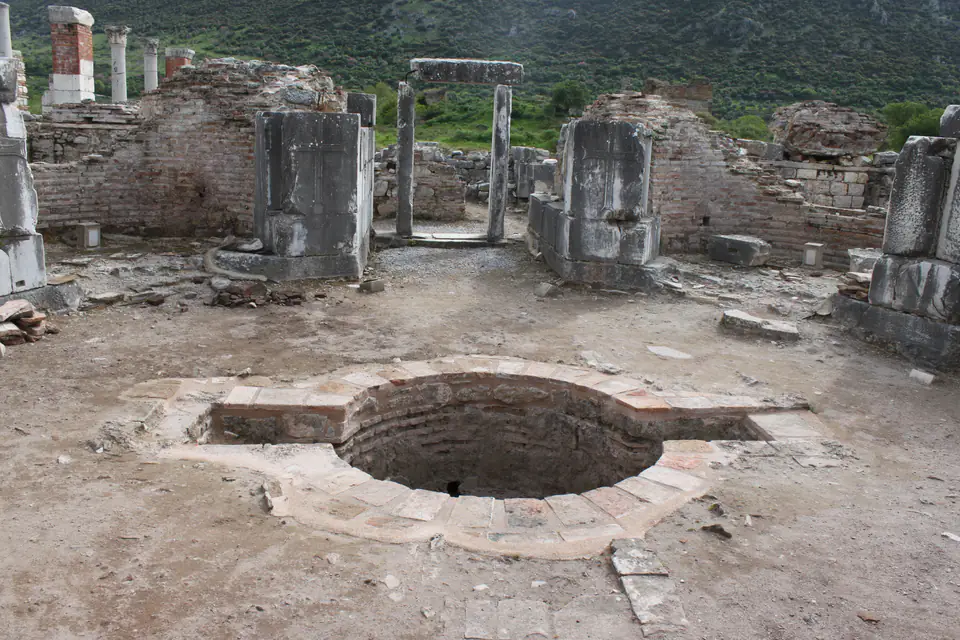
Re-erected columns and a lintel in the Church of Mary, with low ruins and hills behind
Fig. 7 The surviving Church of Mary complex. Archive photograph (2015).

Around Ephesus

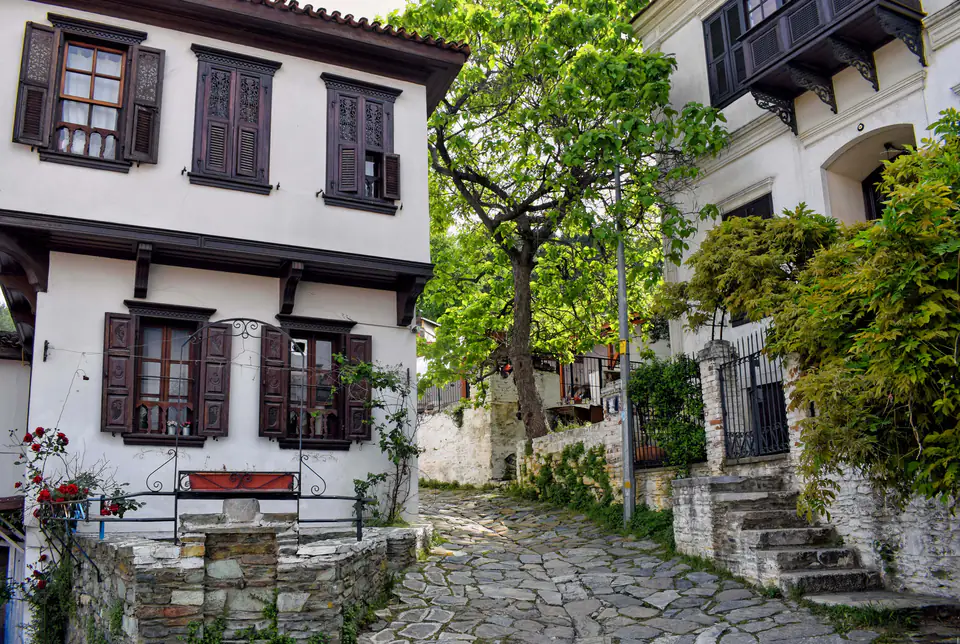
The places around Ephesus begin with Selçuk, the town that carried on the city’s life on and below Ayasuluk hill27. The hilltop holds a Byzantine fortress as well as St John’s basilica76, and at its foot is the İsa Bey Mosque, which an architect from Damascus built in 1375 for an Aydınid ruler36. Up in the hills 8 km east of Selçuk is the village of Şirince77, and 14 km north-east of Ephesus stands the early Hellenistic Mausoleum of Belevi78.

Şirince village of white-walled, tile-roofed houses on a green hillside, with a minaret
Fig. 8 Şirince village of white-walled, tile-roofed houses on a green hillside, with a minaret.

Visiting Ephesus

Because both gates have ticket offices, a visit to Ephesus can run in either direction through the site19. Summer is hard going. July and August bring average daily highs near 35 °C, with 17 or 18 days in each month reaching that mark79. Nearly all the year’s rain falls between October and April80, and the shoulder seasons are gentler, with average highs of about 26 °C in May and 24 °C in October81.

Prices and hours change often, and tickets and opening hours dates every figure it gives. Selçuk’s railway station is a 3.5 km walk from the Lower Gate82, close enough to make the train a practical way of getting to Ephesus. Guiding in Turkey is restricted to licensed tourist guides with a working card83, and a guide’s licence can be checked in their union’s public database84.

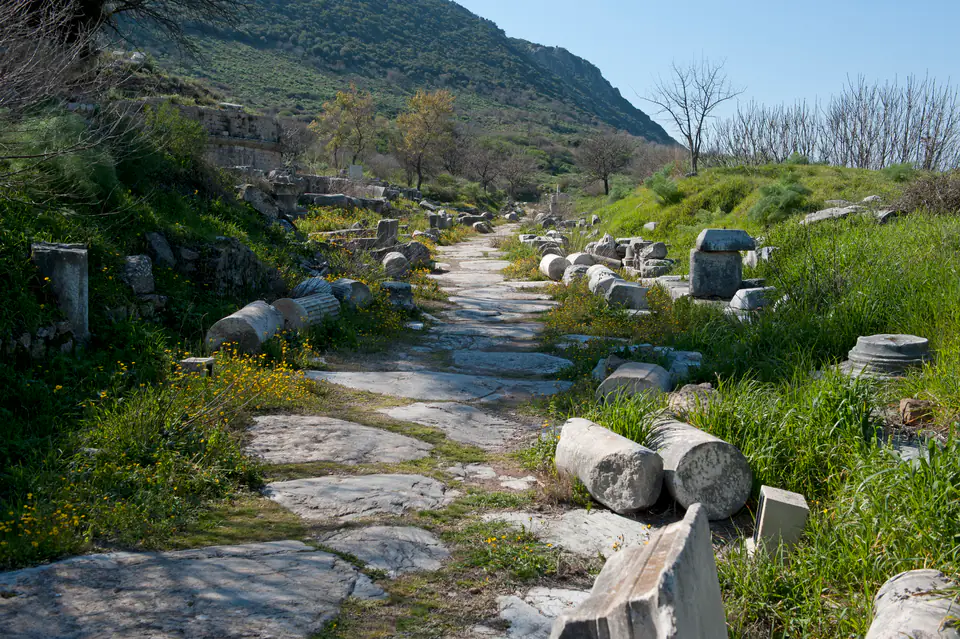
Looking down Curetes Street past columns and statue bases, with visitors
Fig. 9 Looking downhill along Curetes Street.

Things often said about Ephesus that are not true

Ephesus has gathered its share of myths, and what guidebooks get wrong takes them monument by monument. Six that the evidence does not support:

  • “The library was moved abroad.” It stands on its own foundations; statues from it went to Vienna43.
  • “The Octagon holds Cleopatra’s sister.” The remains are those of a boy85.
  • “The Octagon skull was lost in the Second World War.” It sat in a University of Vienna collection all along86.
  • “Paul preached in the theatre.” In the Acts account his friends kept him from going in87.
  • “Lysimachus built the theatre.” The excavators date its beginnings to the 2nd century BC, long after his death88.
  • “Hagia Sophia’s columns came from the Temple of Artemis.” A medieval legend61.
The ruined stage-building foundations of the Great Theatre seen from above
Fig. 10 The remains of the Great Theatre’s stage building.

How this site checks its facts

Factual statements carry numbered references. Historical claims require at least two independent sources; changing visitor information may use the issuing authority’s own notice. Where scholars disagree, the page gives the range and says so. Prices and opening hours show the date they were last checked. Who writes the site, how sources are chosen and how to report an error are explained in about and method.

Closely spaced Greek lettering carved into a pale marble slab in a museum display
Fig. 11 An inscribed marble slab from Ephesus in the Ephesos Museum, Vienna.
Sources (142)

Each source is listed once. The numbers link back to the claims it supports; dates show when the source was checked.